


On 9 June, timed to London Tech Week, Peter Kyle and Rachel Reeves announced a scheme to reimburse visa fees for scale-ups hiring international talent, alongside a new concierge service for high-growth firms.
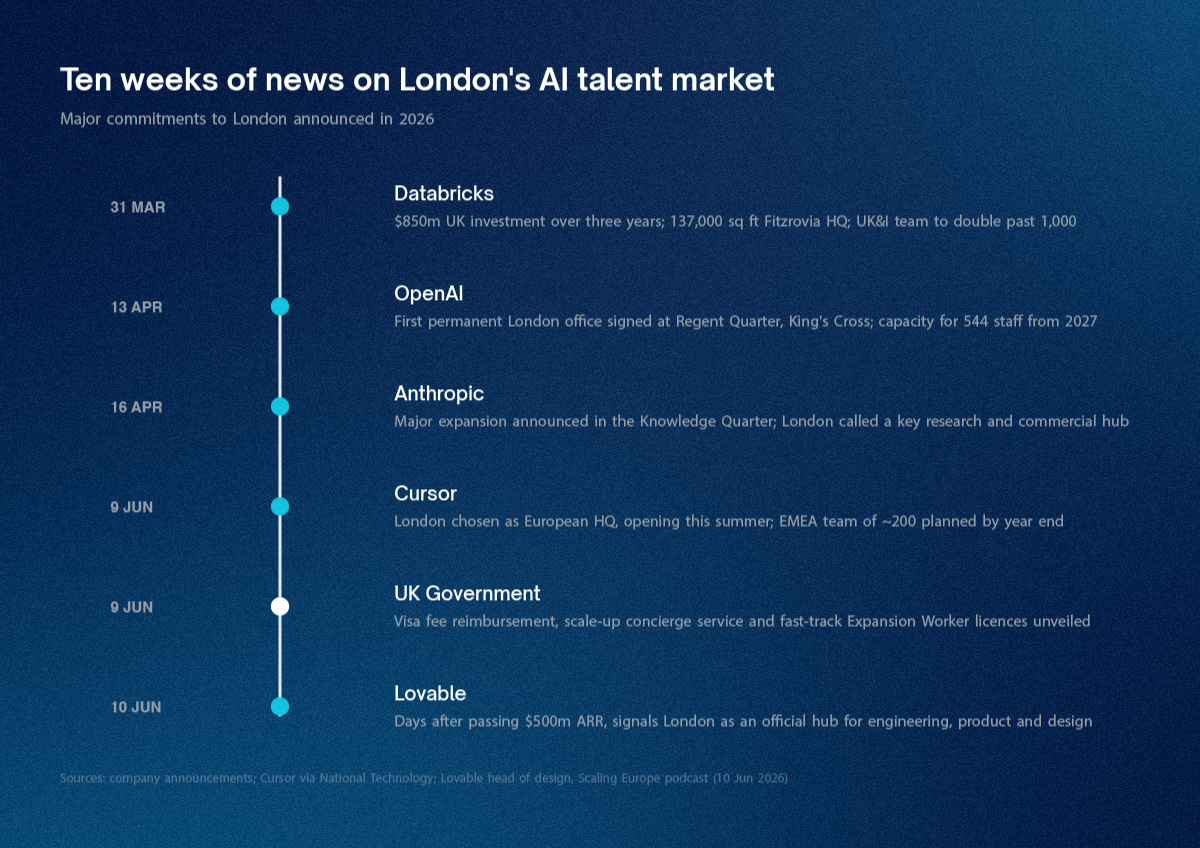
In the same week, Cursor announced its European headquarters in London, with plans to reach roughly 200 EMEA employees by the end of the year – the latest in a string of AI firms honing in on the capital as a hub.
Those two stories have been covered separately this week. For anyone hiring into an AI firm in the UK right now, they are the same story, and the second one will likely do more to your hiring plan than the first.
What was announced
The package has three parts. The first, a tiered concierge service to help the most promising scale-ups deal with regulation, finance, procurement and talent.
Second part is a visa fee reimbursement scheme for scale-ups in digital and tech, life sciences and clean energy, which will let qualifying firms claim up to £5,000 per employee, capped at £25,000 per year. Lastly there’s a fast-track route to a UK Expansion Worker sponsor licence, so international companies can set up here more quickly.
The ambition is to produce the UK’s first trillion-dollar company, and the framing is “start, scale, and stay”. That last word being a key one the UK doesn’t have a great history of achieving.
Why a policy like this exists
Pull the thread on “stay” and you find the problem the scheme is actually aimed at. The UK is good at producing companies, historically less good at keeping them through the scaling years.
Arm, the most valuable technology company Britain has produced, chose Nasdaq over London for its 2023 listing. Wise, one of UK fintech’s flagship firms, moved its primary listing to New York last year. DeepMind, the original UK AI success story, sold to Google at a stage where today it might have raised and stayed independent.
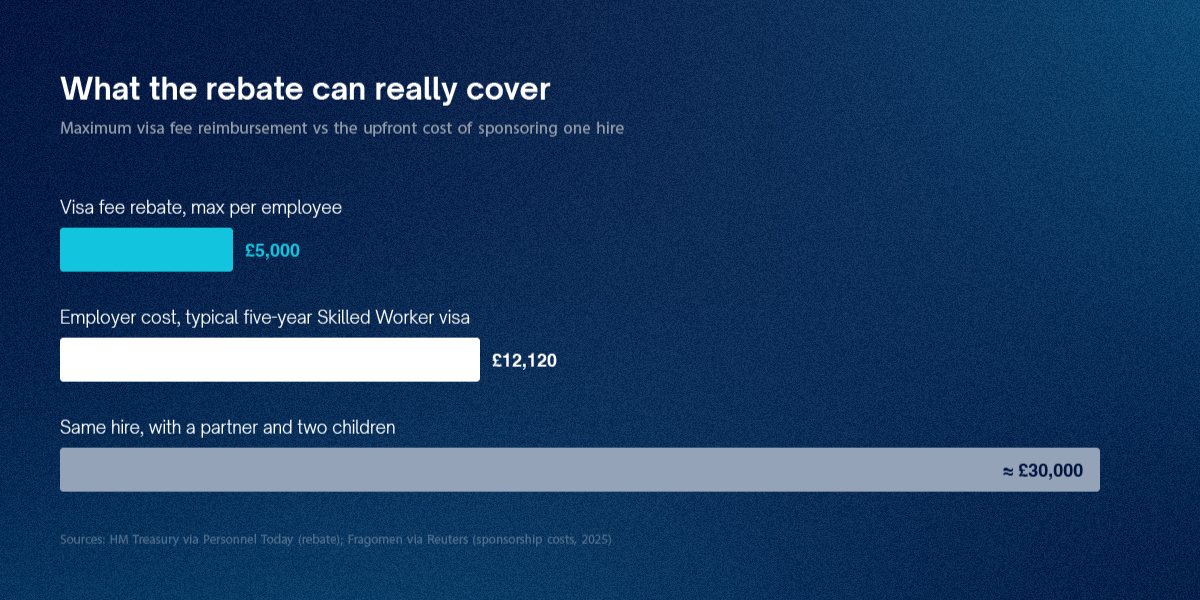
On the talent side, the difficulty in getting people in is well documented – UK upfront immigration costs are up to 17 times higher than the average across comparable nations. Reuters put the employer cost of a typical five-year skilled worker visa at £12,120, nearly 60% more than in 2021, and around £30,000 once a partner and two children are added. For a seed-stage company deciding whether to sponsor a brilliant engineer from outside the UK, that’s a huge hiring decision to make.
What this changes for a founder
Less than you might think. Set £5,000 per employee against £12,120 of upfront cost per sponsored hire and the scheme covers under half of one. The £25,000 annual cap is roughly two senior international hires’ worth of relief. Useful, at the margin where one strong candidate needs sponsorship and the budget conversation is tight. Not the thing that changes your entire hiring plan though.
There is also a tiering question. The concierge service and reimbursement are aimed at the “most promising” scale-ups, with eligibility criteria unclear. The government’s own definition of a high-growth firm, borrowed from the OECD, requires 10 or more employees and 20% annual growth over three years. Plenty of seed-stage AI companies hiring their first international engineers will sit outside whatever line gets drawn.
If you might qualify, find out early and build it into your cost model, if you do not, the practical advice is the same as it always was: get your sponsor licence sorted before you need it, because doing it mid-offer is how you lose candidates to companies that already have one.
One more thing worth noting – the fast-track Expansion Worker sponsor licence helps international companies set up in the UK faster. That is good for the ecosystem and for UK GDP, and it also means the next Cursor gets its London office staffed more quickly. The scheme designed to help British scale-ups keep talent also smooths the path for the companies competing with them for it.
Who’s now hiring against you
The visa scheme is a response to the supply side of the talent market. What has actually moved this year is demand, and it has moved hard towards London.
Here’s some news over the last 10 weeks alone. Cursor’s London HQ is set to open this summer and is expected to hold around 200 people by year end, hiring across engineering, GTM, customer success and operations, off the back of EMEA revenue that has been tripling quarter on quarter. OpenAI signed for its first permanent London office in King’s Cross, an 88,500sq ft site built for over 500 staff.
Anthropic announced a major expansion in the Knowledge Quarter, calling London one of its most important research and commercial hubs outside the US. Databricks committed $850m to the UK over three years, quadrupling its London footprint and planning to double its UK and Ireland team past 1,000. And Lovable, the fastest-growing startup Europe has produced, this week announced the build out of a London office and active hiring in GTM and product.
So what does this mean for hiring into a startup?
These firms are moving in to expand, hiring engineers, applied ML people, sales, customer success and operations, exactly the profiles a Series A AI company needs. They pay top of market, the brand does half the selling, and they give strong candidates a London – or broader UK – option that carries prestige without startup risk.
Comp benchmarks for AI-adjacent engineering and GTM roles in London will jump up, and candidate processes will get more competitive. If your offer relies on being the most exciting AI thing a candidate has seen that month, that bar just shot up.
But big offices deepen pools as well as drain them. Every one of these expansions pulls senior international talent into London, some on the very visas this scheme subsidises, and a meaningful share of those people will want a startup in three or four years.
We have watched this play out before; DeepMind and the Google and Meta London offices seeded a generation of UK AI founders and early employees. The arrival of Cursor, OpenAI, Anthropic and Databricks at scale is also a long-term supply story.
What we would actually do with this
If you are a founder or hiring lead at a scale-up, the advice is to treat the visa scheme as a small, welcome cost offset and chase eligibility if you are close to it, but do not let it change your view of what sponsorship costs or how early to get licensed.
Assume the candidates you want are also talking to one of the big new London offices, and sharpen the things they cannot match, like autonomy and ownership, equity that means something, speed of decision, and direct access to the people building the company. And expect the pool of strong international candidates open to London to grow, because the combined message of this policy and those expansions is that London is where the European AI market is consolidating.
The government wants its first trillion-dollar company. Whether this policy delivers that is a question for 2030. What is true today is that the war for AI talent in London just gained four or five very well-funded participants, and a £5,000 rebate will not be the thing that decides who wins it.