

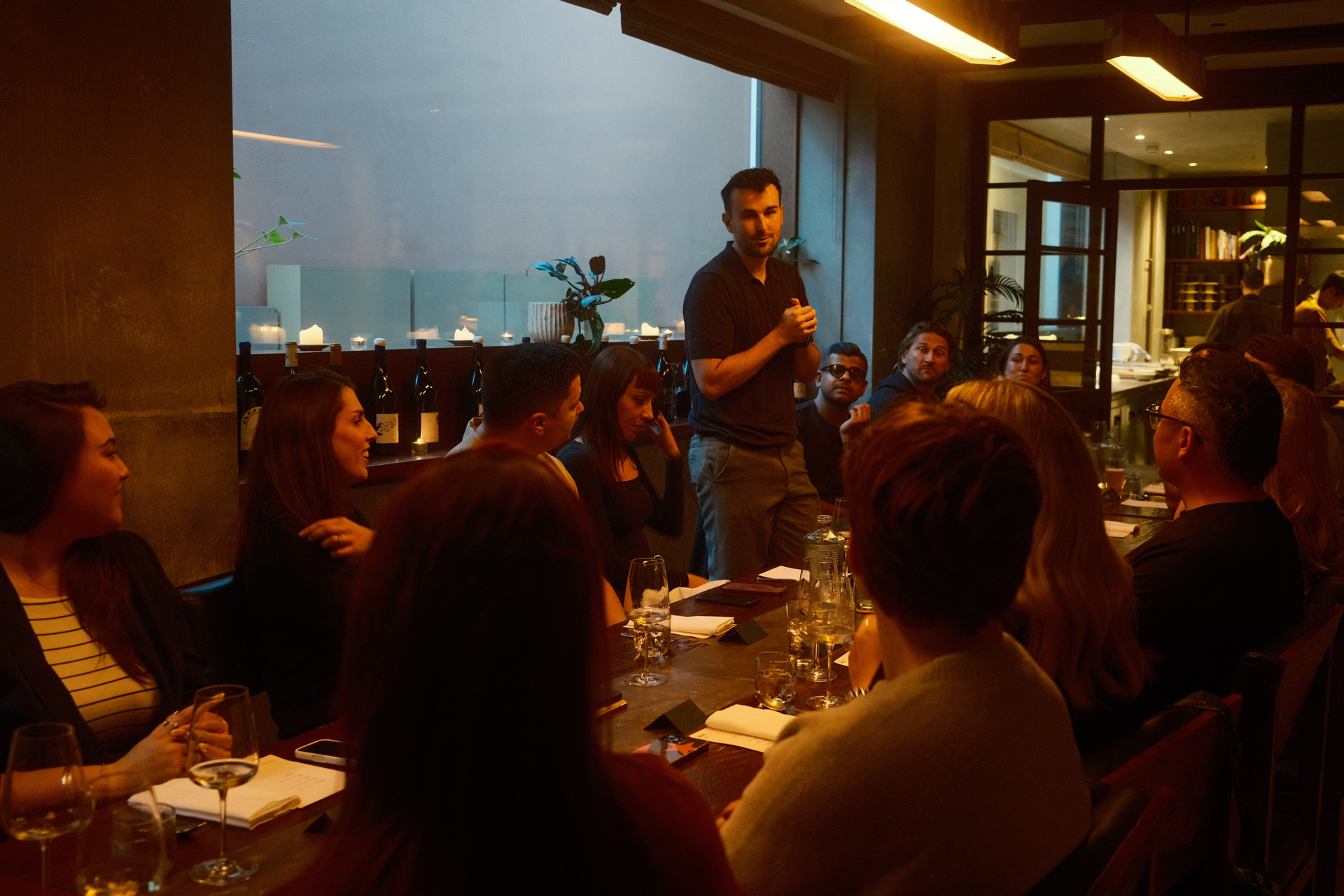
Earlier this month we put the people and talent leads from some of the country’s top AI firms round one table for dinner. There’s a pre-existing web of connections that exist between the talent teams hiring amongst these firms – most already know each other in some way, have worked together before, or knows someone who knows someone – so we thought it’d be valuable to come together to share ideas over some good grub.
We held the event at the chef’s table at KOL, Marylebone, Santiago Lastra’s restaurant which was awarded a Michelin star in 2022 – when we arrived a couple of the people joining us said it had been on their lists for ages, so we were off to a good start even before a plate had been laid.
There were sixteen TA leaders from frontier labs, research-led AI companies and AI-native product firms, along with four of the Cubiq team. We spoke openly about the current state of hiring in today’s market – here are some of the insights from the table.
Everyone wants “the best engineers”, but mechanisms of assessing them vary
A discussion about how and when candidates are assessed through an interview process showed how differently teams are going about finding the best engineers, particularly around AI-assisted coding.
At one company, candidates code alongside an agent from the first technical stage, and plenty of strong engineers trip up because they’ve never been assessed in that way.
At the other candidates code without one. Some trip up there too, as agentic tools have become so central to how they work day to day. Everyone at the table had a we only want the best mentality, but how that was assessed in practice varied hugely.
It’s a split you can openly observe outside of this table. Canva rebuilt its technical interviews last year around AI-assisted coding and found that candidates with minimal experience with AI struggled, not because they couldn’t code, but because they lacked the ability to guide AI effectively. Meta has been piloting its own AI-enabled coding rounds, describing them internally as more representative of the environment its engineers will go on to work in. Anthropic has gone the other way for live assessment – its candidate guidance allows no AI assistance during live interviews unless the company says otherwise. All names you’d associate with hiring top-tier engineers, all with different mechanisms of identifying what top-tier is.
The risk for anyone hiring engineers is running an interview built for one assessment while the team works the other way. And if your process is going to test something candidates don’t expect, it’s worth telling them up front, because you’ll lose good people to surprise rather than ability.
A similar pattern came up with forward deployed engineers. Most of the table was hiring some version of it, but definitions differed firm-to-firm – a pattern we’ve seen first hand when taking briefs for clients on the role.

Collaboration is being tested earlier
There were a couple of examples of people putting a collaboration exercise, a structured behavioural assessment, right at the start of their process rather than leaving it to the final stage. Their technical interviews score how candidates explain what they’re doing and bring the interviewer along, as well as whether the code works.
As tooling absorbs more of the raw implementation, how someone reasons out loud and works with others is being tested more. OpenAI’s interview guide says it evaluates engineering candidates for strong communication and collaboration skills, and asks them to show how they consider and solve problems.
If collaboration matters to how your team works, testing it last means spending your most expensive interview hours on people who might fail on it.
Past a certain point more money stops being effective
Compensation came up from almost everyone at the table: how do you weigh the impact someone will have against what you can pay them?
The largest players have fully reset the top of the market. Sam Altman said last year that Meta had offered some of his staff signing bonuses as high as $100 million, with even larger annual compensation packages. When everyone competing for the same person can pay at the top of the range, extra money does less and less, and the offer is decided on everything else.
SignalFire’s 2025 State of Talent report found 80% of Anthropic employees were still there at the end of their second year, against 67% at OpenAI and 64% at Meta. It credits Anthropic’s draw to things beyond pay: intellectual discourse, researcher autonomy, flexible working, clear routes for career growth.
Past a certain level of package, plenty of people will take a bit less for work they believe will matter. The driver varies:
- For some it’s conviction in the company.
- For some it’s the impact they’ll have.
- For some it’s the stage, and what they’ll get to own that a bigger organisation can’t offer.
It’s different for every single person, so effective qualification at the very earliest stage becomes paramount – reinforcing those individual drivers at every stage of process, and when it gets down to offer you need to know more than your competitor does about what matters to the person in front of you.
Reaching people who aren’t looking
Kiera got chatting to one of the guests about a candidate being exclusively represented by her, not on the market, and someone at the table asked what that truly meant. Those not actively applying are typically the researchers and engineers everyone wants – but why signal to an agency rather than directly to your next dream workplace directly?

Replying to an in-house recruiter means telling a company, often one sitting in the same small community as their current employer, that they’d consider leaving. In a field where everyone knows everyone, the reply itself is a sign that many people aren’t comfortable making directly to internal teams without knowledge of where that information will end up.
It isn’t always a lack of interest, but replying means saying “I’m looking” to people who might mention it to someone, who might mention it to someone, and plenty of strong candidates would rather stay quiet.
This is why so much of the conversation was about individual motivations, approaches, and tapping into candidate drivers. The key thing that works is ensuring the candidate has as little to commit to in order to assess whether they think it’s worth their time.
A conversation with an agency carries less weight for a candidate. It doesn’t tie them to any one company or tell a future employer anything, so they can explore without anyone knowing they’ve looked. That lower bar is often what gets the first conversation started, and it’s what makes the partnership useful for in-house teams hiring at this level.
When the team you’re building almost reaches the layer above it
Companies that keep raising the bar at individual contributor level eventually find the gap between them and the leadership layer becomes smaller and smaller. It’s a product of success and a sign that you’re hiring well, but does become an internal equity challenge further down the line.
One person described joining a company partly to help build a tier of senior leaders above established heads of function, adding more experience at the top.
Deel’s CEO Alex Bouaziz told Fortune he was advised to replace his leadership team as the company scaled. Instead, he recommends reimagining senior leaders’ roles, and hiring someone else to cover any gaps.
Join the conversation on the next one
None of the questions raised at the table have a standard right answer, but there was an openness to share what the approach is toward getting close to one.
If you’d like to be in a room full of people doing the same tough job and comparing their efforts towards it, which we know doesn’t happen often in this market, we’re planning our next dinner now. We’ll be bringing new faces into the room alongside the people who’ve been part of this first one.
If you hire into AI and this sounds like a room you’d like to be part of, you can sign up for future events here.